How a refrigerated container works
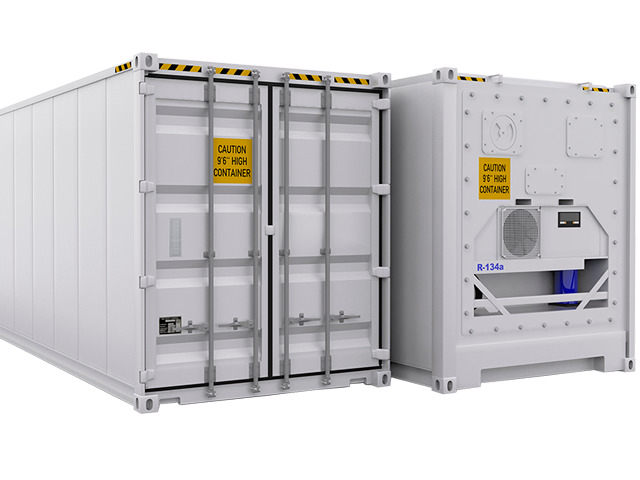
Refrigerated containers are used as reusable packaging designed for long-term transportation and storage of cargo within specific temperature ranges of the reefer container operation (from -25 to +25 °C).
The main application of reefer containers is sea and railway transportation, and they are also used as small warehouses in stationary mode. The most popular types are 20-foot containers and 40-foot containers.
The length of a 20DC container is 6060 mm, width – 2438 mm, height – 2590 mm. External dimensions are 5650*2350*2230 mm, weight – 3000 kg, maximum load capacity – 28000 kg.
The length of a 40DC container is 12192 mm, width – 2438 mm, height – 2590 mm. External dimensions are 12080*2430*2100 mm, weight – 5000 kg, maximum load capacity – 40000 kg.
Design of a reefer container
The cooling module differs from a standard one by the system of jumpers. To maintain the cold inside the reefer container, multilayer wall and floor structures are used. In modern standard reefers, sandwich panels are used instead of profiled metal sheets. The front side is reinforced because the refrigeration unit is installed there. This is also where the pipelines carrying the refrigerant into the container are located.
The module walls are three-layered. The outer layer is a corrugated sheet with a profile depth much smaller than in standard models, the inner layer is a thin duralumin sheet, and between them is an insulating plate to preserve the supplied cold.
The floor and ceiling also use a “sandwich” structure. Instead of regular planks, the floor is covered with a thin metal panel used to seal the insulation layer. Behind the inner ceiling lining run the pipes supplying cold air. The ceiling is equipped with ventilation openings, ensuring that during transportation the cargo must not touch the top panel.
The containers may be equipped with racks or shelves for storing products during transport.
Specifics of reefer units
Before understanding how a reefer container works, it is important to remember that all refrigeration units operate on the same principle. They differ only in the set of regulators.
If the loaded cargo requires negative temperatures, the cooling mode is activated. If you are unsure how to turn on the reefer container, use the switch located on the front console. Then the suction of the refrigerant via the intake line begins, and it is compressed and sent to the heat exchanger. Here the hot refrigerant cools and transitions to a liquid phase. A fan removes the released heat. Complete liquefaction occurs in the receiver. Through the filter, the refrigerant moves to the TXV valve. It then evaporates into gas, cooling the evaporator housing.
Thermoboxes can operate in the following modes:
- freezing: down to -30 °C;
- cooling: from -10 to +2 °C;
- heating: above +2 °C.
Additional thermal insulation is used to save electricity.
Advantages of reefer containers
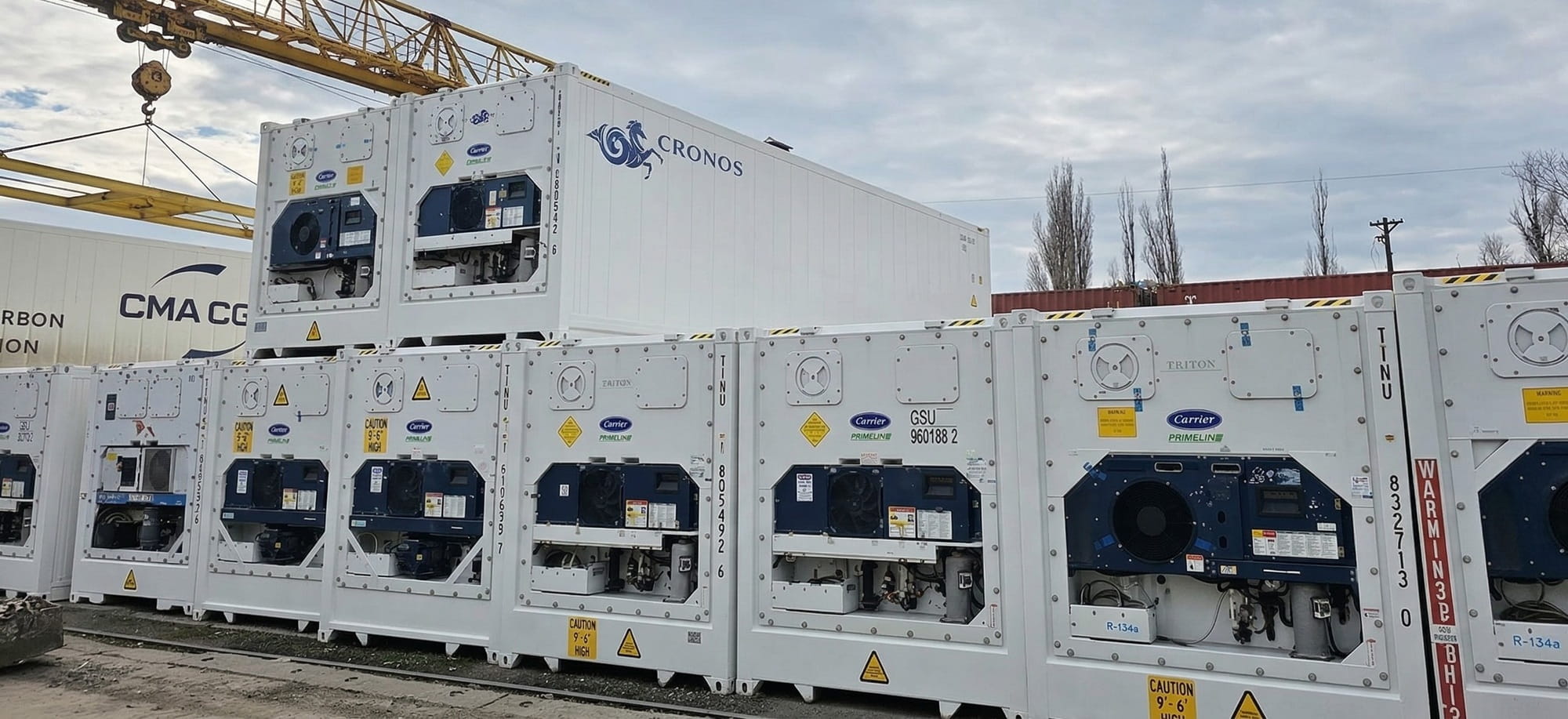
The advantages of these devices include:
- the cargo is preserved regardless of transportation conditions;
- the equipment operates autonomously and reliably;
- a wide temperature range: from -25 to +25 °C;
- available modes: freezing and defrosting;
- humidity inside the chamber can be controlled;
- in case of a power outage, the temperature will be maintained for a long time;
- they can be used as a freezer, cold storage, or greenhouse environment.
Airflows are evenly distributed and circulate inside the module. After setting the desired mode, the cargo can be monitored by the operator via sensors. These units are designed for long-term continuous operation while consuming electricity efficiently. Error notifications are displayed through the electronic system.
What power do reefer containers consume?
An important characteristic is the energy consumption of the reefer container. Its power requirement depends on the set temperature and the ambient temperature. All modules use the same power supply: 360/460 V. To connect them, a 4-core copper cable (6–8 mm) is required.
Refrigeration unit
The main characteristic of a reefer container unit is the preset temperature in the cargo compartment. Adjustment is performed using a microcontroller system (step of 0.1 °C). The operation is fully automatic.
Buying or renting a reefer container
The best manufacturers of reefer containers are Japan, China, South Korea, and the USA. Purchasing a reefer container requires significant financial investment. A good alternative may be renting a reefer container for a certain period.
To install a reefer container, a level surface must be arranged. If this is not possible, it may be placed on two reinforced concrete blocks.
Our Partners
Today, our company services a number of large linear companies operating in Ukraine. Such as:






























Want to stay informed?
Subscribe to our newsletter, and we'll notify you about new promotions, special conditions for partners and new clients, and market changes.