Installing a Flexitank in a Container
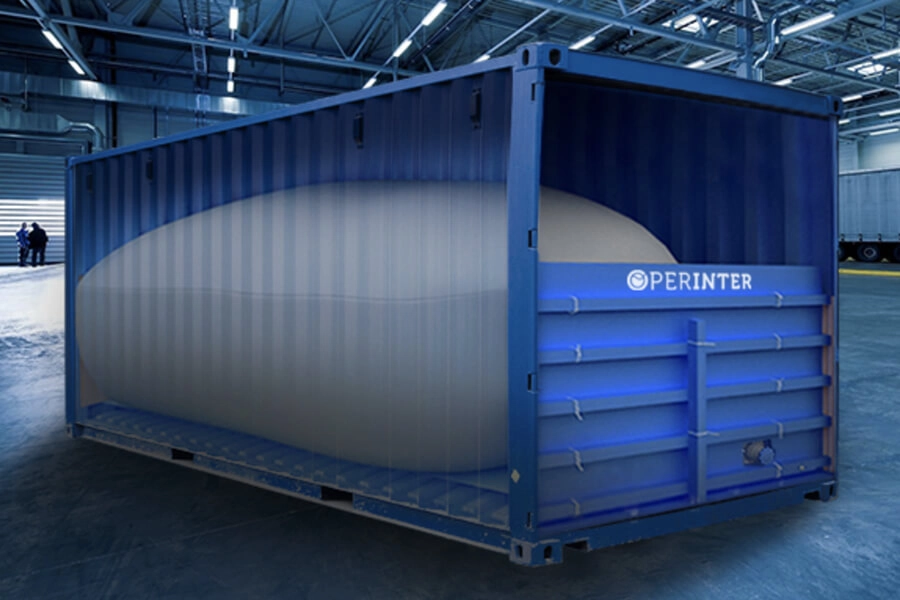
Installation of flexitanks is a set of works on installing a disposable or reusable flexible polymer liner (flexitank) in sea dry cargo containers for temporary storage and transportation of bulk liquids with a useful volume of 10,000-24,000 liters.
Submit a requestInstalling a flexitank in a container is in demand among logistics operators, manufacturers, and suppliers of food products and certain types of non-hazardous technical liquids. Compared to the use of tank containers, flexitanks in many cases make it possible to reduce transportation costs, simplify logistics, and increase the usable volume of transported cargo.
Why GCS?

Extensive experience
GCS has been working with container equipment for transporting various types of cargo for over 28 years.
Turnkey projects
The preparation of the container, installation of flexitanks, and testing of the system for tightness are carried out at one terminal.
Operational safety
The flexitanks used are certified according to COA (Container Owners Association) and comply with the requirements of PAS 1008:2016.
Qualified personnel
Installation is carried out by trained specialists who strictly follow the manufacturers' requirements and safety regulations.
Flexitank Installation: Specifics of Work at GCS
The process begins with selecting a container. For installation, it is permissible to use dry cargo containers whose technical condition complies with the liner manufacturer’s requirements. In most cases, it is recommended to use containers that are no more than 5 years old. If necessary, at Global Container Service you can rent a dry container fully prepared for flexitank installation.
Stages of flexitank installation work:
- Technical inspection – the dry shipping container is inspected for uncleaned weld seams, sharp edges, floor damage, door deformations, as well as the operability of hinges, locking bars, and locking mechanisms.
- Preparatory measures – elimination of discrepancies identified during the inspection is carried out, along with container cleaning, protection of protruding elements with special tape, and installation of corrugated cardboard protective sheets in the corners (completely) and along the side walls (to a height of at least 150 cm).
- Flexitank installation – the folded liner is unrolled on the container floor from the far wall toward the front door, after which an end bulkhead (partition) is installed at the doors and the loading/unloading fittings for liquids are connected (elbow, ball valve, suction-pressure hose, and quick coupling).
- Heating system installation (optional) – for viscous or thickening-prone products, a steam or water heating system may be provided.
- Installation quality control – after installation, the correct positioning of the liner, the reliability of the flexitank fastening, and the tightness of the connections are checked. Burst tests with an eightfold load are carried out by the flexitank manufacturer under factory conditions, not at the terminal during each installation.
- Container marking – warning stickers and information plates are applied in accordance with carrier requirements.
How to order the installation of a flexitank?
The client fills out the feedback form on the website and sends a request for the installation service of flexitanks.
The deadlines, scope of work, and price of the flexitank installation are agreed upon with the client.
A technical inspection and assessment of the container's suitability for installing the flexitank is being carried out.
Defects are eliminated, cleaning is performed, internal surfaces are protected, and fastenings are installed.
Upon completion of the installation, a final inspection is carried out and warranty documents are issued.
Order Flexitank Installation
Fill out the form — our specialist will contact you to clarify the order for flexitank installation.
As a rule, flexitanks are installed in 20-foot containers. 40-foot shipping containers are used for these purposes much less frequently due to weight limitations and wall reinforcement requirements. After flexitank installation, the container may be temporarily placed at the GCS terminal as part of the container storage service until shipment to the customer.
A wide range of liquid cargoes is transported in flexitanks: wines, vegetable oils, molasses, syrups, concentrated fruit and berry juices, food additives, industrial fats and oils, lubricants, synthetic resins, latex, glycerin, liquid detergents, and other non-hazardous chemicals.
The use of flexitanks makes it possible to increase the usable load of a container compared to transportation in drums, IBC totes, and other small packaging, and in some cases reduce costs compared to the use of tank containers for liquid cargoes. An additional advantage of disposable flexitanks is the absence of the need to return empty packaging, which helps reduce logistics costs.
By design, flexitanks can be single-layer or multilayer. Single-layer flexitanks are made of durable polyethylene approximately 1 mm thick. Multilayer flexitanks consist of several polyethylene layers with an outer protective shell made of woven polypropylene.
Frequently Asked Questions about Flexitank Installation

About Global container service
Global Container Service is the Ukrainian market leader in the field of terminal services for containers of all types. The company combines an expert team, developed infrastructure and a wide network of partners to provide comprehensive solutions for container logistics.
Our goal — help you develop your business in the field of container transportation, provide it with technical solutions, the necessary service and equipment. We work so that you can optimize costs, increase efficiency, make your business more technically and financially flexible.
More about us